On this page
Marketing emails are messages a business sends to promote its products, services, or content to people on its list. If an email's main job is to sell, announce, or bring someone back, it's a marketing email. That label matters, because it decides which legal rules apply and how readers judge it.
This guide covers the definition, the 9 types you'll use most, four real emails from Linear, Cycle, Basecamp, and Lenny's Newsletter, and the rules that keep you out of the spam folder.
- A marketing email promotes a product, service, or piece of content. Receipts and password resets are transactional emails instead.
- Nine types cover most programs: welcome, newsletter, promotional, product update, onboarding, lead nurture, event, abandoned cart, and re-engagement.
- Good marketing emails chase one goal, use one main button, and read well on a phone.
- In the US, CAN-SPAM requires an honest subject line, a postal address, and a working unsubscribe link.
- Gmail's bulk sender rules add one-click unsubscribe and SPF, DKIM, and DMARC authentication for high-volume senders.
What Are Marketing Emails?
A marketing email is any email whose primary purpose is commercial. The FTC's CAN-SPAM compliance guide draws the line by purpose: commercial messages promote a product or service, while transactional or relationship messages complete a deal or update an existing account.
Here's the practical split:
- Marketing emails: newsletters, sales, launch announcements, webinar invites, and win-back offers.
- Transactional emails: order confirmations, shipping notices, password resets, and warranty or safety notices.
The gray zone is the mixed email. The FTC treats a message as commercial if its subject line promotes a product, or if the transactional part isn't mainly at the top. So a receipt with a big upsell banner and a "Save on your next order" subject line is a marketing email in the eyes of the law.
The 9 Types of Marketing Emails
Pick the type by the job you need done, not by what your competitors send. Most email programs run on these nine.
| Type | Main goal | When it goes out |
|---|---|---|
| Welcome | Set expectations and get a first action | Right after signup |
| Newsletter | Build trust with regular, useful content | Weekly or monthly |
| Promotional | Drive a sale or upgrade | Launches, sales, and seasonal moments |
| Product update | Get users to try new features | After a release |
| Onboarding | Help new users reach their first win | The first days and weeks after signup |
| Lead nurture | Move a prospect toward a sales call or trial | After a download or demo request |
| Event invitation | Fill a webinar, launch, or conference | In the weeks before the date |
| Abandoned cart | Recover a purchase left unfinished | Hours after the cart is abandoned |
| Re-engagement | Win back inactive users or subscribers | After weeks or months of no activity |
Each type has a failure mode. Newsletters fail when they turn into weekly ads. Promotional emails fail when every send is a "last chance." Re-engagement emails fail when you keep sending them to people who stopped opening a year ago. At some point, removing those contacts protects your sender reputation more than another nudge will.
Real Marketing Email Examples
Real emails teach faster than definitions. The first three below are screenshots of actual SaaS emails archived by SaaSFrame, with credit to each brand. The fourth is a newsletter you can read on the web today.
Linear's Welcome Email Built on Three Links
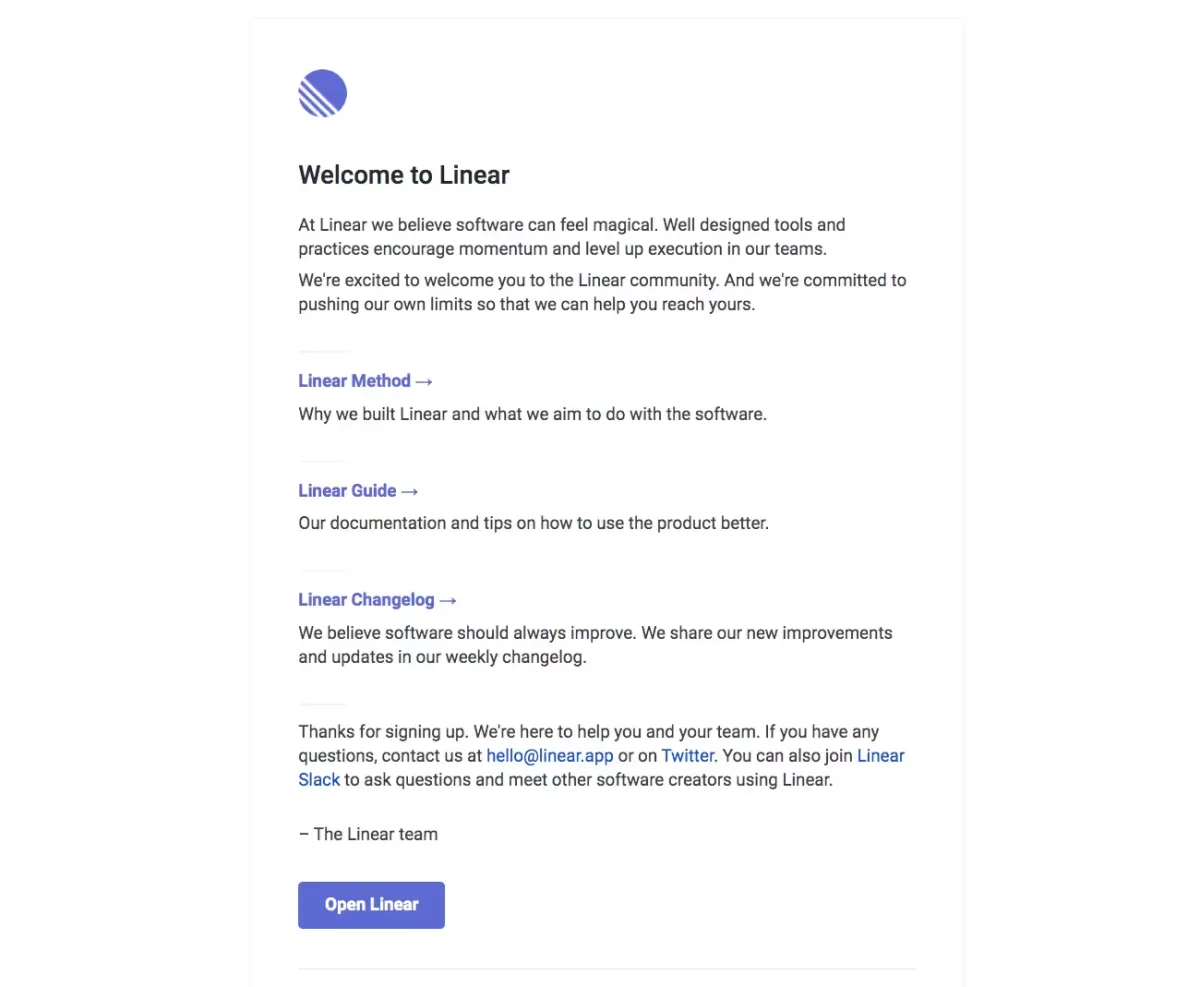
Linear's welcome email, archived on SaaSFrame in July 2020, opens with a two-sentence point of view about software that feels magical. Then it offers exactly three links: the Linear Method, the Linear Guide, and the Linear Changelog. Each gets one line explaining why you'd click.
The lesson: a welcome email doesn't need to pitch. It tells the reader what the brand believes and where to go next. The one tradeoff is focus. Three links plus an "Open Linear" button gives the reader four choices, which works for curious users but can dilute a single activation goal. See the original in SaaSFrame's Linear welcome email archive.
Cycle's Product Update That Summarizes First
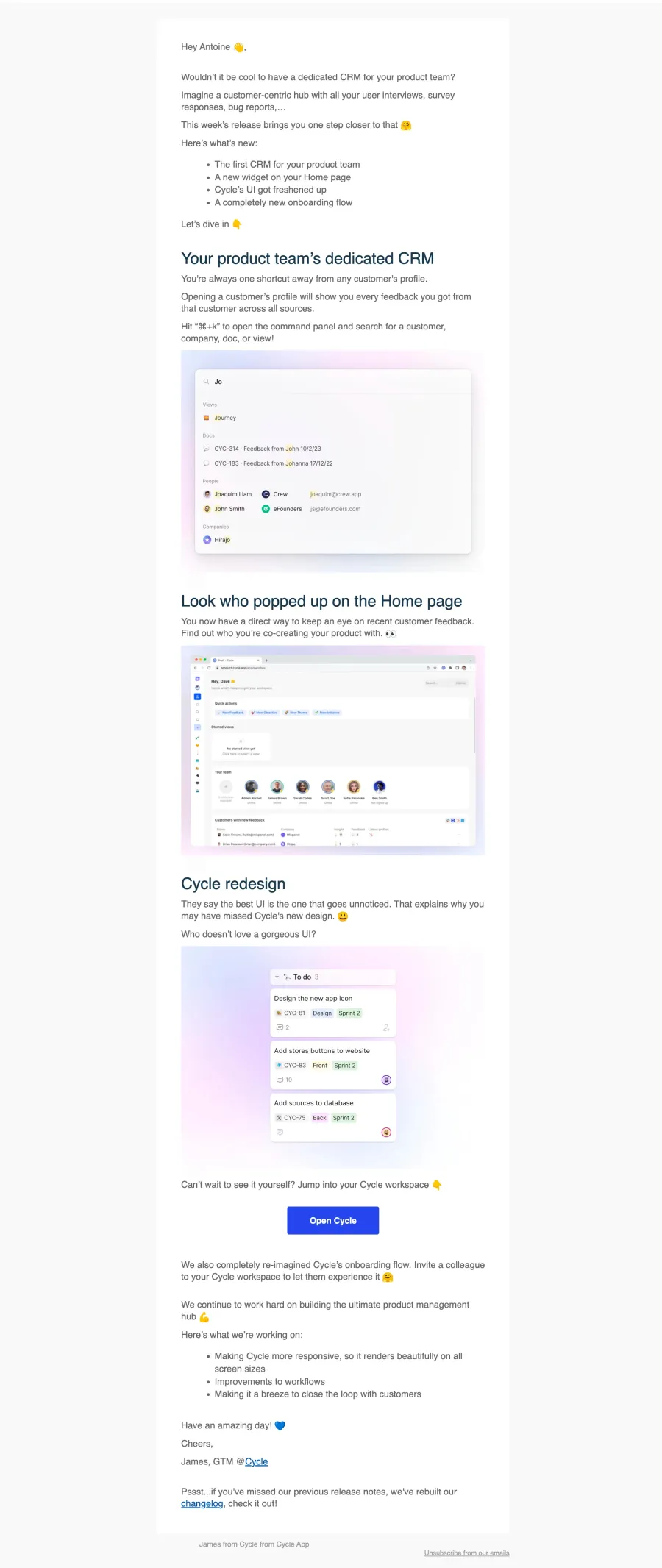
Cycle's release email opens with a four-bullet "Here's what's new" list. After that, each feature gets its own heading, two or three sentences, and one product screenshot. There's one blue "Open Cycle" button, then a short "what we're working on" list and a sign-off from a named person on the team.
This is the format to copy for product updates. Skimmers get the whole release from the top list. Interested users scroll for detail. The roadmap list at the end gives readers a reason to open the next update too. View it in SaaSFrame's Cycle product update archive.
Basecamp's Win-Back Email With an Honest Exit
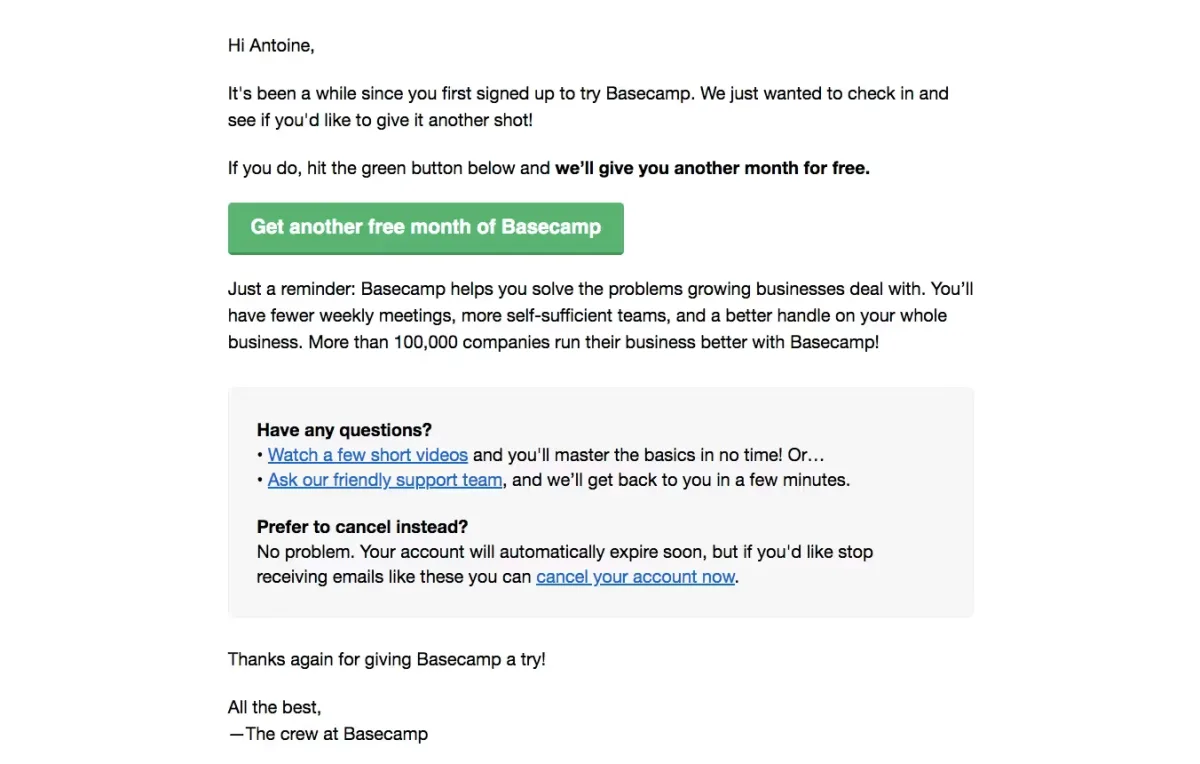
Basecamp's re-engagement email makes one offer in bold: come back and get another month free. A single green button repeats the offer. Below it, a gray box handles the two other likely replies: "Have any questions?" links to short videos and support, and "Prefer to cancel instead?" links straight to account cancellation.
That cancel link is the smart part. It respects the reader, and it gets people who'll never return off your list cleanly. The email also uses a proof point, more than 100,000 companies, but it's Basecamp's own claim, so treat any number like that as the sender's marketing. See the original in SaaSFrame's Basecamp retention email archive.
Lenny's Newsletter: When the Newsletter Is the Product
Lenny's Newsletter describes itself as a deeply researched advice column about building product, driving growth, and advancing your career. Its about page claims more than 1,000,000 subscribers. Paid subscribers get every issue, the archive, and a private Slack community.
The lesson for B2B brands: a newsletter earns attention when each issue is worth reading even if the reader never buys. Promotion works when it's a small part of a send people already want.
What Makes a Good Marketing Email?
A good marketing email gets one specific reader to take one specific action. Everything else supports that action. Use this checklist before you hit send.
- One goal. Decide the single action you want. Basecamp's email has one button for one offer.
- A subject line that matches the body. Clever is fine. Misleading is a legal problem under CAN-SPAM.
- The point in the first two lines. Many inboxes show a preview, so the opener has to carry the message.
- Scannable structure. Short paragraphs, a summary list, and clear headings, like Cycle's release email.
- A human sender. A named person in the sign-off reads warmer than "The Team."
- Mobile-first layout. Single column, large tap targets, and images that still make sense if they don't load.
- An easy exit. A clear unsubscribe link protects your list quality and your sender reputation.
Measure results against your own history, not someone else's average. For context, Mailchimp's email marketing benchmarks list an average open rate of 35.63% and a click rate of 2.62% across all users, based on data last updated in December 2023. Mailchimp also warns that Apple Mail Privacy Protection can affect open rate accuracy, so judge campaigns on clicks and conversions first.
Design matters too. If you're building a recurring send, our email newsletter design guide covers layout, typography, and visual hierarchy in more depth.
Are Marketing Emails Legal? Rules to Follow
Yes, marketing emails are legal in the US, but they must follow the CAN-SPAM Act. The FTC's CAN-SPAM guide sets out these core requirements:
- Use accurate "From," "To," "Reply-To," and routing information.
- Don't use deceptive subject lines.
- Identify the message as an ad.
- Include a valid physical postal address.
- Tell recipients how to opt out, and keep that option working for at least 30 days after sending.
- Honor opt-out requests within 10 business days.
- Stay responsible even when an agency or platform sends on your behalf.
There's no exception for business-to-business email. Each violating email can cost up to $53,088 in penalties, according to the FTC.
Inbox providers add their own rules. Google's email sender guidelines say senders of 5,000 or more messages a day to Gmail accounts must authenticate with SPF, DKIM, and DMARC. Their marketing emails need one-click unsubscribe and a visible unsubscribe link in the body. Google also says to keep the spam rate reported in Postmaster Tools below 0.30%.
What is a good marketing email?
A good marketing email has one clear goal, a subject line that matches the content, and one main call to action. It reads well on a phone, shows a real sender, and makes unsubscribing easy.
What are the 7 types of emails?
There's no single official list of seven. Most marketers group emails into welcome, newsletter, promotional, product update, onboarding, re-engagement, and transactional emails. This guide splits marketing emails into nine types, adding lead nurture, event, and abandoned cart emails.
What are 10 popular emails?
Popular email types include welcome emails, newsletters, sales promotions, product updates, onboarding sequences, lead nurture emails, event invitations, abandoned cart reminders, re-engagement emails, and order confirmations. The last one is transactional, not marketing.
Is it legal to send marketing emails?
Yes, in the US, if you follow the CAN-SPAM Act. Use honest headers and subject lines, identify the email as an ad, include a postal address, and honor unsubscribe requests within 10 business days.
Do marketing emails need an unsubscribe link?
Yes. CAN-SPAM requires a clear way to opt out of marketing email. Gmail also requires bulk senders to support one-click unsubscribe and show a visible unsubscribe link in the message body.
Need more inspiration for your next campaign? Browse our marketing collateral examples to see how brands carry one message across emails, one-pagers, and sales assets.
Summarize this article with AI:
 ChatGPT
 Perplexity
 Claude
 Grok

Written by
Taher BatterywalaFounder & Chief Curator
Taher Batterywala is a creative marketer who loves to write & design content that organically drives conversions. He is the creator of Pineable, the world's first content marketing design inspiration hub. He regularly shares his thoughts about content design, SEO, and marketing. As a true cinephile, he admires movies above anything else.
