On this page
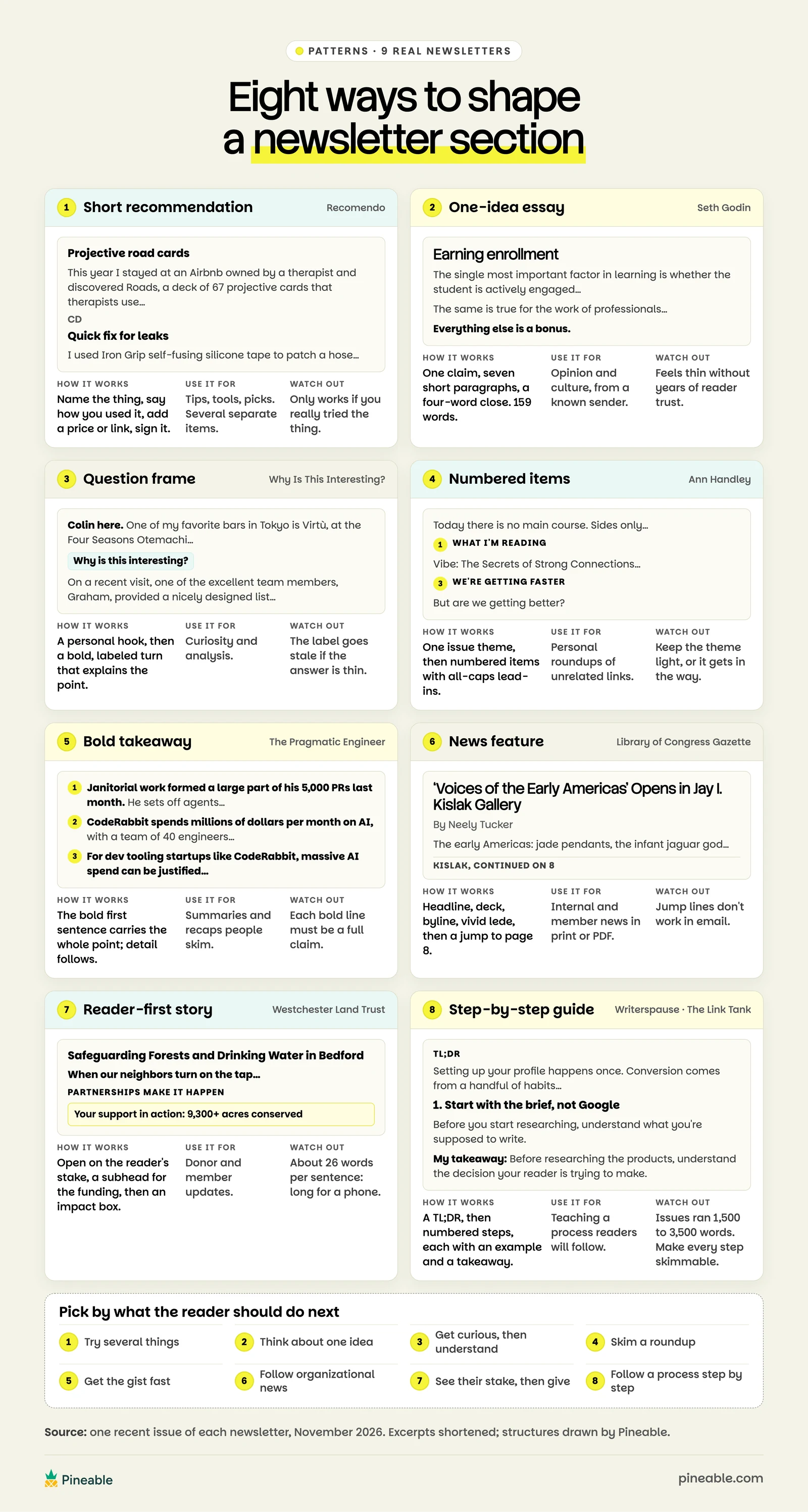
Your subscribers opted in, but that doesn't mean they'll read past the first line. Every section of a newsletter competes with a full inbox, and each one has to earn the next few seconds.
So what do sections that earn them look like? We read recent issues of nine newsletters, from Recomendo's 100-word picks to the Library of Congress staff Gazette and Writerspause's step-by-step guides, and counted the words in every section. Most email sections ran 30 to 160 words, and each one put its point in the first line.
Below are eight section patterns you can copy, each with a real example, why it works, and where it breaks, plus how long a section should run and a five-step way to write one.
- Put the point in the headline or first sentence; every example here does this.
- Most email sections we counted ran 30 to 160 words, about 8 to 40 seconds of reading.
- Print and internal features ran longer sentences: about 26 words, against 10 to 19 in email.
- Label the turn: "Why is this interesting?" or "Why it matters" tells readers why to keep going.
- Mark sponsored items clearly, as Recomendo does, so trust in the editorial items holds.
- A long how-to issue works when each step is its own short section; Writerspause's steps ran 74 to 299 words, and The Link Tank opens with a TL;DR.
Newsletter Article Examples at a Glance
Each example below teaches one writing move. The links go to the public issue or archive we read.
| Newsletter | Section type | What works | Source |
|---|---|---|---|
| Library of Congress Gazette | Internal news feature | Headline, deck, byline, vivid lede, jump line | Gazette archive |
| Westchester Land Trust | Print donor feature | Opens on the reader's tap water, ends on impact | Fall 2025 newsletter PDF |
| Recomendo | Short recommendation | Thing, proof, price, initials, about 94 words | Issue #541 |
| Why Is This Interesting? | Question-framed opener | Personal hook, then a labeled turn | Tokyo Cocktail Bars Edition |
| The Pragmatic Engineer | Numbered takeaways | Bold first sentence carries the point | Harjot Gill episode post |
| Seth Godin | One-idea essay | 159 words, seven short paragraphs | Earning enrollment |
| Ann Handley's Total Annarchy | Personal numbered items | One theme ties five items together | TA #222 |
| Writerspause (Divya Sharma) | Step-by-step guide | Ten numbered steps, each with an example and a takeaway | How to Write a SaaS Comparison Article |
| The Link Tank (Melanie Goodman) | Long-form guide | A TL;DR first, then numbered steps and one closing takeaway | LinkedIn followers into Substack subscribers |
What Is a Newsletter Article?
A newsletter article is a single piece of writing inside a newsletter issue, written for people who already chose to hear from you. That last part changes the job. A blog post has to win a stranger from search. A newsletter article has to earn the next 30 seconds from someone who knows you and has a full inbox, a desk tray, or a break room table.
| Newsletter article | Blog post | Promotional email | |
|---|---|---|---|
| Reader | Subscriber, member, or employee | Searcher who may not know you | Customer or lead |
| Job | Inform or connect, one point per section | Answer a query in full | Get one click or purchase |
| Typical length | About 30 to 320 words per section in our sample | Whatever fully answers the query | Short, built around one offer |
| Success looks like | Read, replied to, passed on | Ranked, read, linked | Clicked, bought |
This guide covers the writing inside each section. For visual design, such as columns, fonts, and colors, see our email newsletter design guide. For other kinds of email, from onboarding to product updates, see our guide to marketing emails.
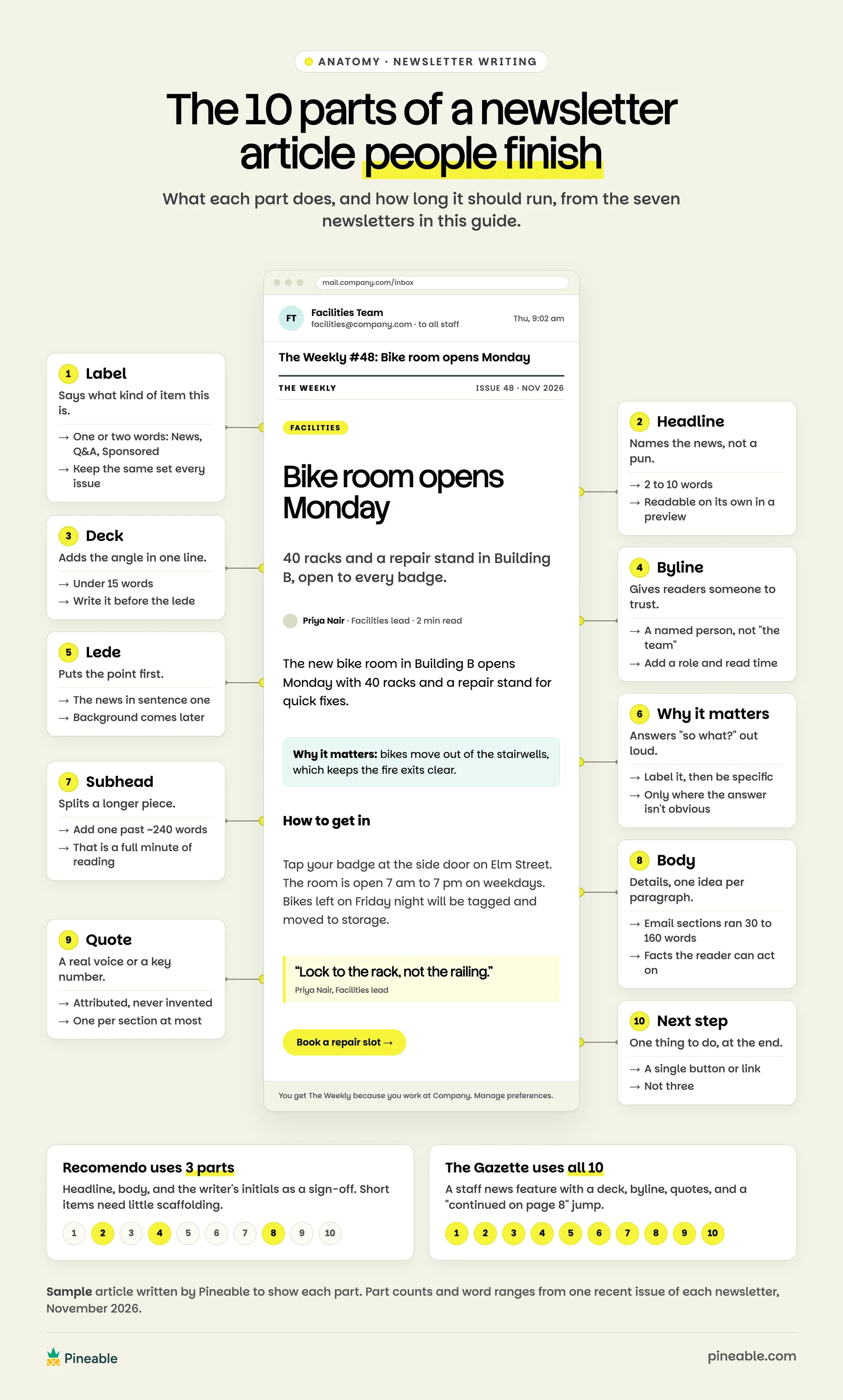
Not every section needs every part. Recomendo uses a headline, a body, and initials. The Gazette uses all of them. Pick the parts your reader needs to decide whether to keep reading.
The Pin DropFree, every Tuesday
We pin down why great designs work.
Every Tuesday: new entries from the Pineable library, the week's standout launches and one close look at a single design.
How Long Should a Newsletter Article Be?
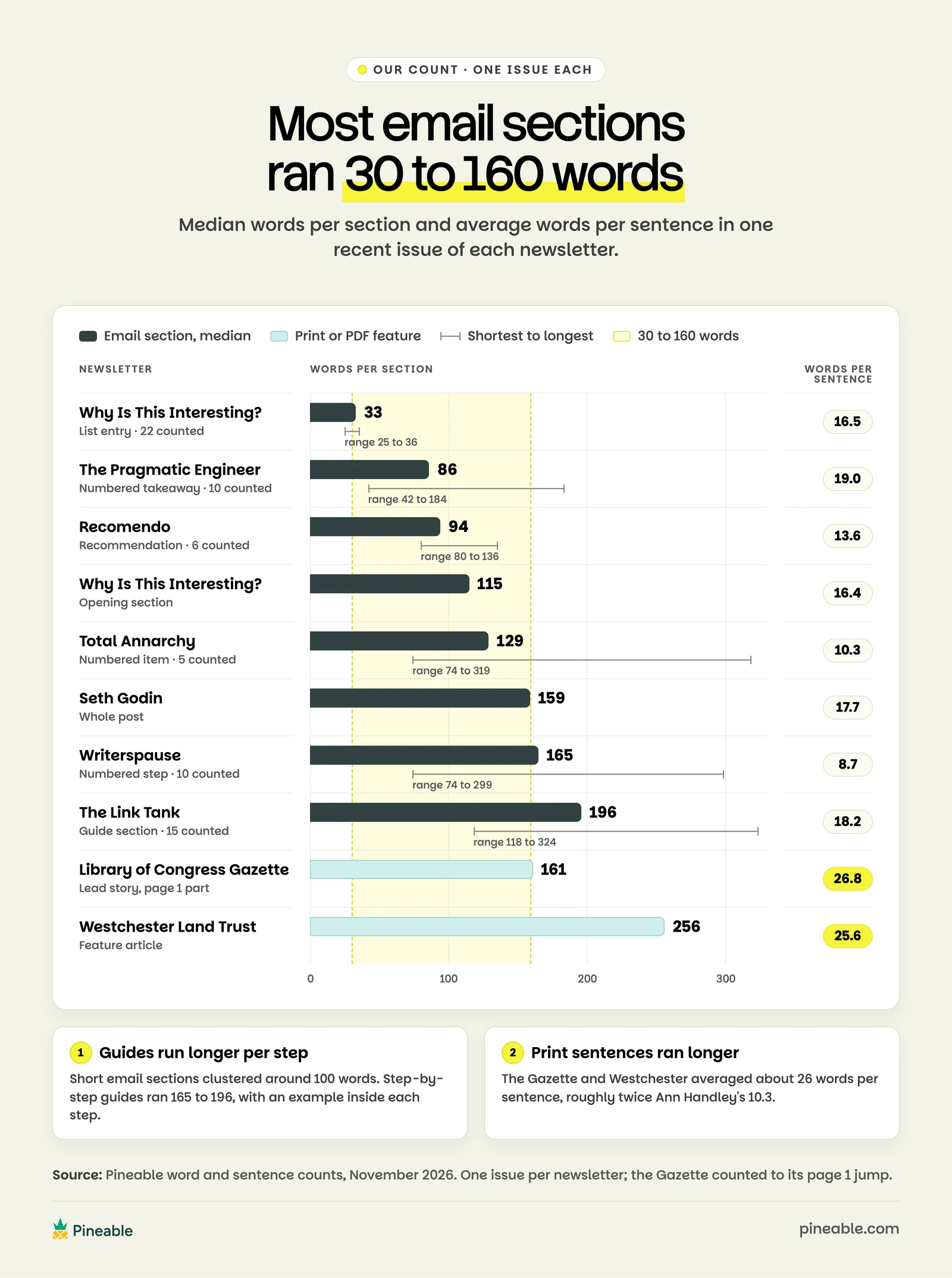
Most email newsletter sections in our sample ran 30 to 160 words. The print and internal features ran longer, at 161 to 256 words before a jump or page turn. We counted words and sentences in one recent issue of each newsletter in November 2026, using a script on the issue text.
| Newsletter (issue date) | Unit counted | Units | Words per unit, median (range) | Avg. words per sentence |
|---|---|---|---|---|
| Why Is This Interesting? (Nov 19, 2026) | List entry | 22 | 33 (25 to 36) | 16.5 |
| The Pragmatic Engineer (Nov 18, 2026) | Numbered takeaway | 10 | 86 (42 to 184) | 19.0 |
| Recomendo (Nov 15, 2026) | Recommendation | 6 | 94 (80 to 136) | 13.6 |
| Why Is This Interesting? (Nov 19, 2026) | Opening section | 1 | 115 | 16.4 |
| Total Annarchy (Nov 22, 2026) | Numbered item | 5 | 129 (74 to 319) | 10.3 |
| Seth Godin (Nov 22, 2026) | Whole post | 1 | 159 | 17.7 |
| Writerspause (Nov 14, 2026) | Numbered step | 10 | 165 (74 to 299) | 8.7 |
| The Link Tank (Nov 25, 2026) | Guide section | 15 | 196 (118 to 324) | 18.2 |
| Library of Congress Gazette (Nov 20, 2026) | Lead story, page 1 portion | 1 | 161 | 26.8 |
| Westchester Land Trust (Fall 2025) | Feature article | 1 | 256 | 25.6 |
Two patterns stand out. First, the email-native sections cluster around 100 words, with a long item only when the writer has a story to tell (Ann Handley's "What I'm reading" item hit 319). Second, the print and internal pieces used sentences roughly twice as long as Handley's. Print readers have the whole page in front of them, while email readers scroll one screen at a time. Third, the two step-by-step guides ran longer per section, around 165 to 196 words, because each step carries its own example. Writerspause's low sentence average comes from its checklists of short questions.
Rule of thumb: adults read English non-fiction silently at about 238 words per minute, according to a 2019 meta-analysis of 190 studies. So a 100-word section takes about 25 seconds (100 divided by 238 is 0.42 minutes). A six-item Recomendo issue at about 94 words per item is roughly 560 words, or a bit under 2.5 minutes. If a section runs past 240 words, it is asking for a full minute, so give it a subhead or a link to the rest.
What we did not test: one issue per newsletter is a small sample, so treat these as snapshots, not norms. Script counts can differ by a few words from Word or Google Docs. For the Gazette, we counted only the part of the story on page 1. For The Link Tank, we read four recent public guides and counted the longest, a 3,546-word Sales Navigator tutorial. We didn't measure open rates, clicks, or replies.
To check your own sections, paste them into our free readability checker and compare scores section by section.
Short Items That Respect the Reader's Time
These three newsletters keep each section small. They work best when you have several separate things to share.
Recomendo: Lead With the Thing, Then Your Proof
Recomendo is a weekly email from Cool Tools Lab, written by Claudia Dawson, Kevin Kelly, and Mark Frauenfelder. Its page describes it as six brief personal recommendations and lists over 130,000 subscribers (as of November 2026). In issue #541, every item follows the same order: a plain headline naming the thing, how the writer found or used it, a price or a link, and the writer's initials.
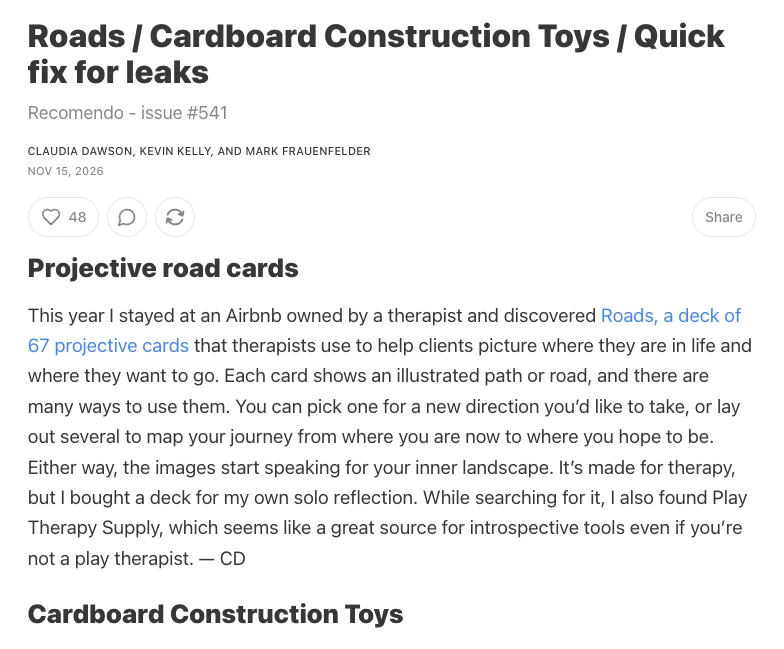
Works because: the proof is personal and checkable. "I used Iron Grip self-fusing silicone tape to temporarily patch a leaky hose" beats any adjective. But: the format only works if you actually tried the thing. Faking first-hand use in 100 words is easy to spot.
The issue also shows how to keep paid content honest. The sponsor block sits under a labeled heading, separated by rules, after the six editorial items.
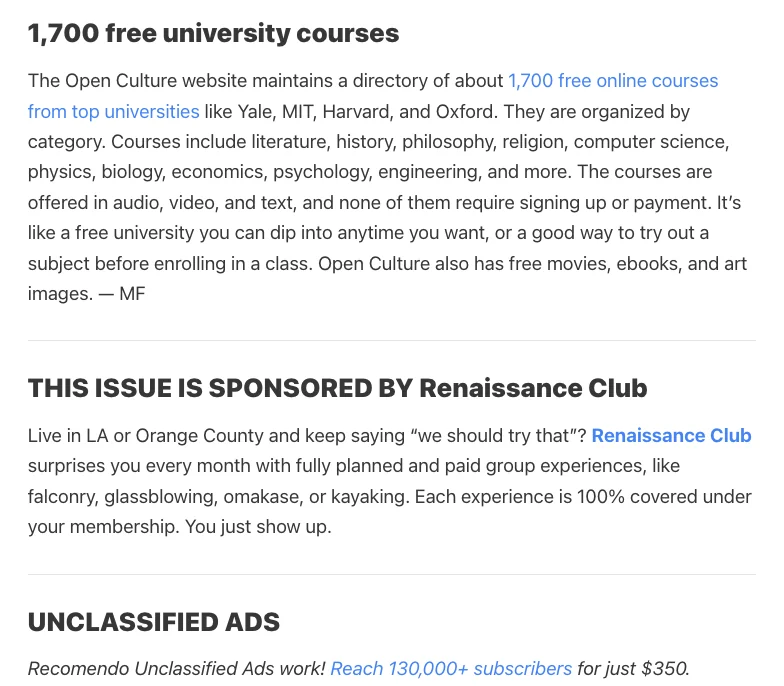
Steal this: end every recommendation with a concrete detail (a price, a count, a size), then sign it.
Why Is This Interesting?: Label the "So What" Turn
Why Is This Interesting? describes itself as a daily newsletter from Noah Brier and Colin Nagy. The Tokyo Cocktail Bars Edition (November 19, 2026) opens with "Colin here." and one favorite bar. Then a bold line asks the newsletter's signature question, "Why is this interesting?", and the answer explains where the list came from. Twenty-two annotated entries follow, each with a name, a neighborhood, and two sentences.
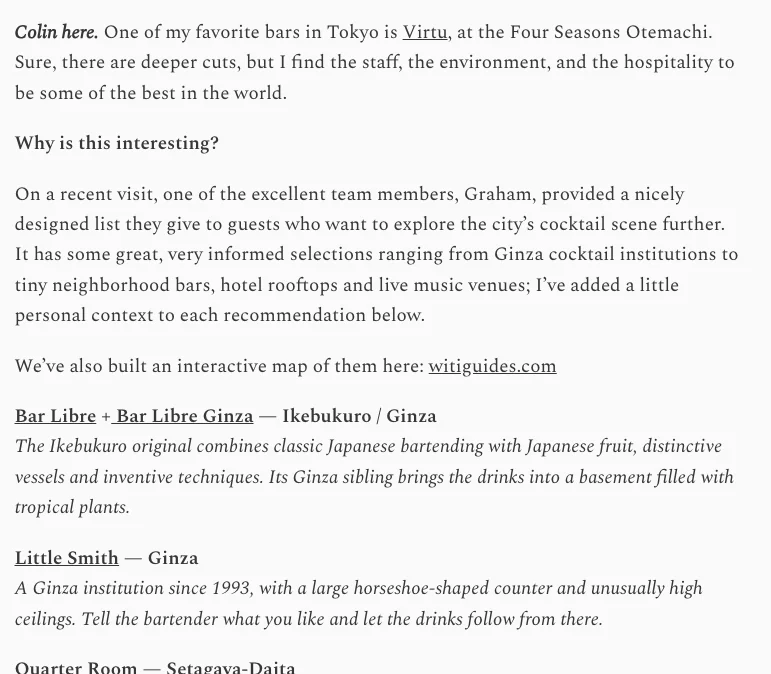
Works because: the labeled question is a promise. Readers know the "so what" is coming, so they read the hook. But: a fixed label gets stale if the answer after it is thin. It only earns its place when the second paragraph adds real context.
Steal this: add a recurring, labeled turn after your opener, such as "Why it matters" or "What changed," and make the answer specific.
The Pragmatic Engineer: Put the Takeaway in Bold
The Pragmatic Engineer, Gergely Orosz's newsletter about software engineering, summarized a podcast with CodeRabbit CEO Harjot Gill (November 18, 2026) as ten numbered takeaways. The first sentence of each is bold and carries the full point. The rest adds examples. Where Orosz adds his own view, he sets it in italics.
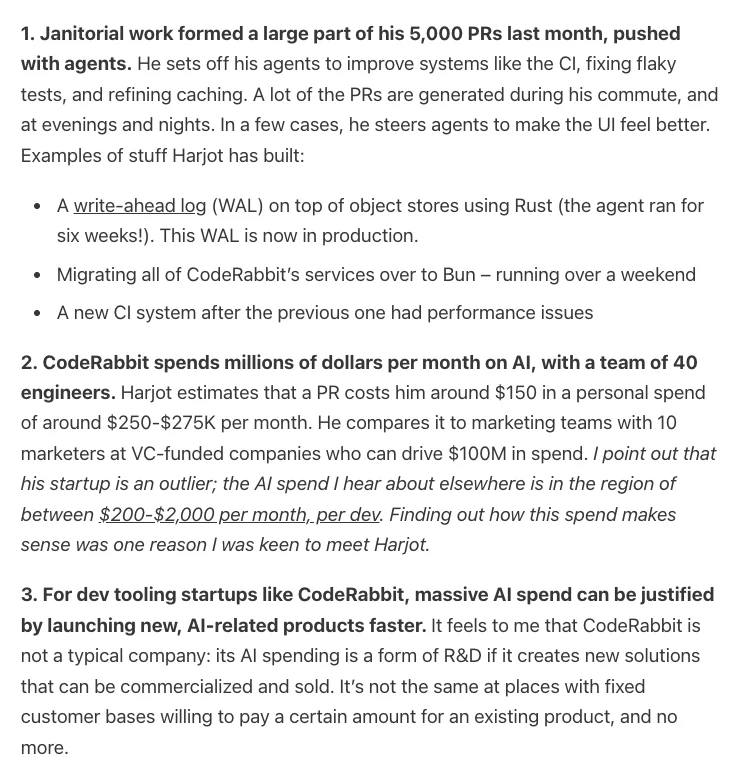
Works because: a skimmer can read only the bold lines and still get the episode. The italic asides keep reporting and opinion apart. But: bold first sentences only work when each one is a full claim. Ten bold fragments would read as shouting.
Steal this: for any recap, write the bold sentence first, as if it were the only line people will read.
Personal Sections That Sound Like a Letter
These two writers build sections around their own voice. Use this approach when readers subscribe for the person, not only the topic.
Seth Godin: One Idea, Then Stop
Seth Godin's blog is also an email; the site's sidebar offers it delivered by email every day. "Earning enrollment" (November 22, 2026) runs 159 words in seven short paragraphs under a two-word headline. It opens with its claim about learning, widens it to professional work, and closes on a four-word line.
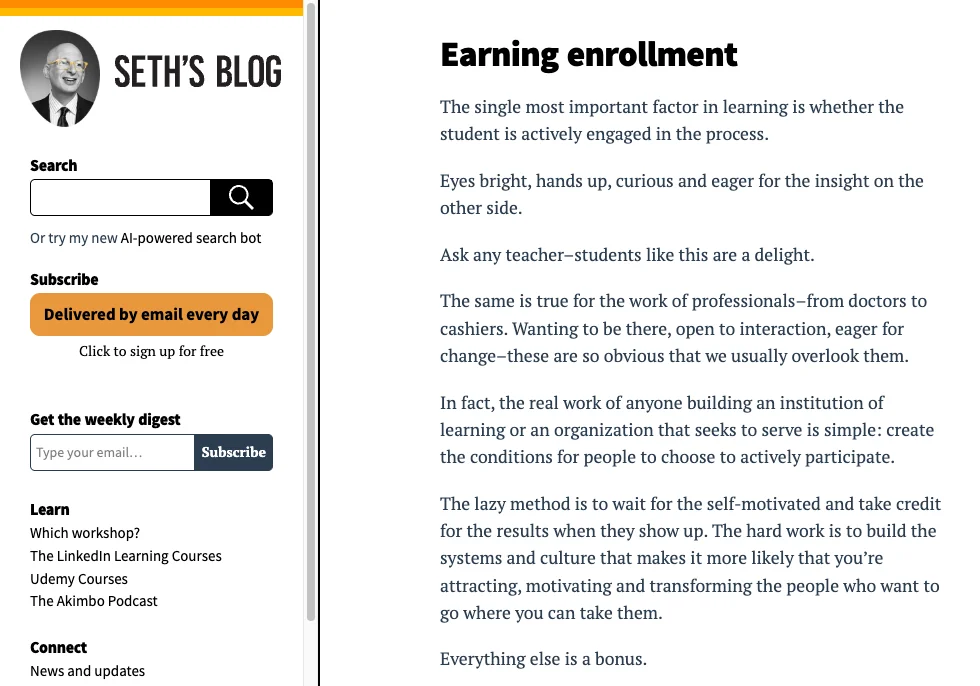
Works because: there is nothing to skip. One claim, one turn, one close. But: this format leans on years of reader trust. A new newsletter with a 159-word abstract essay and no example may feel thin.
Steal this: cut your section to the one idea you'd defend in an argument, then delete the paragraph that restates it.
Ann Handley's Total Annarchy: Tie Every Item to One Theme
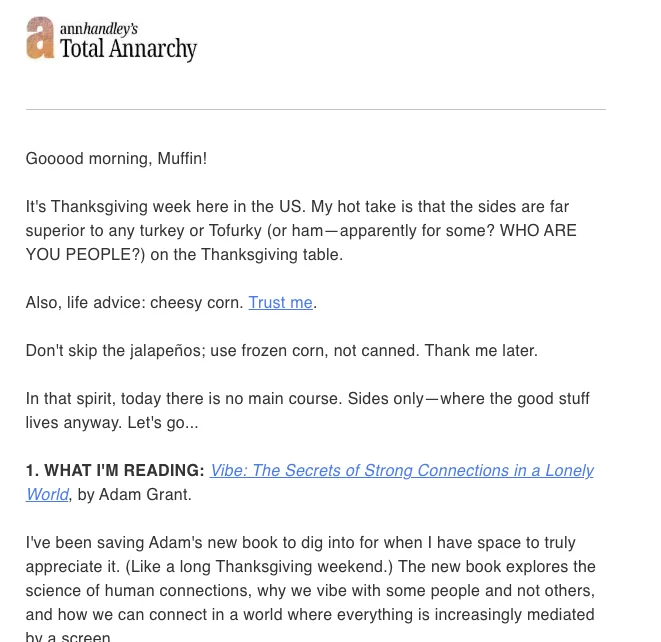
Ann Handley, author of Everybody Writes, sends Total Annarchy through AWeber. Issue TA #222 (November 22, 2026) frames the whole issue around Thanksgiving sides: "today there is no main course." Five numbered items follow, each led by an all-caps phrase such as "WHAT I'M READING."
Item 3 shows how small a section can be. It is one stat graphic, one sentence of context, one bold question, and one link to a replay.
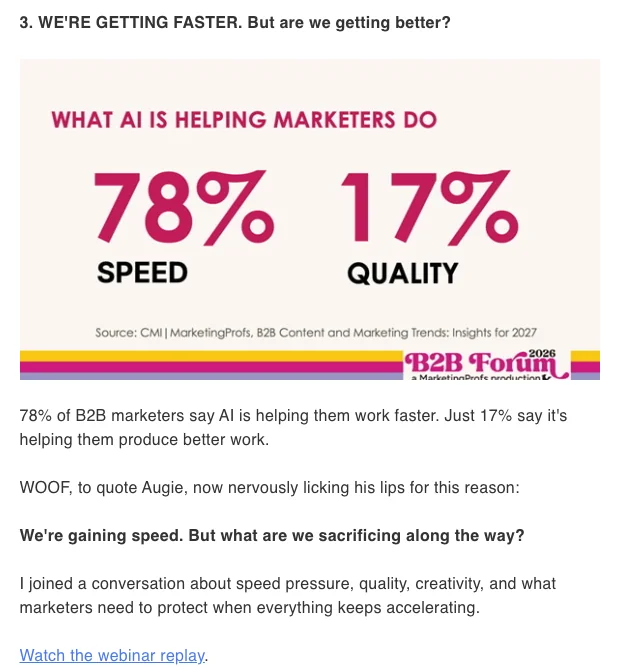
Works because: the theme makes five unrelated links feel like one issue, and the sentences are short (about 10 words on average in our count). But: a theme has to be light. Stretch the metaphor into every item and it gets in the way of the content.
Steal this: pick one idea for the issue's opening, then let each item's all-caps lead-in say what kind of item it is.
Step-by-Step Guides Sent as One Issue
Some newsletters send a whole how-to guide as one issue. These two make a long read easy to follow by turning every step into a short, self-contained section.
Writerspause: Number the Steps, Then Say the Takeaway
Writerspause is Divya Sharma's newsletter for writers and marketers, covering SEO, writing, and client acquisition, sent through beehiiv. "How to Write a SaaS Comparison Article" (November 14, 2026) walks through ten numbered steps, from "Start with the brief, not Google" to "Don't skip the final fact-check." On the web version, each step sits in its own colored card.
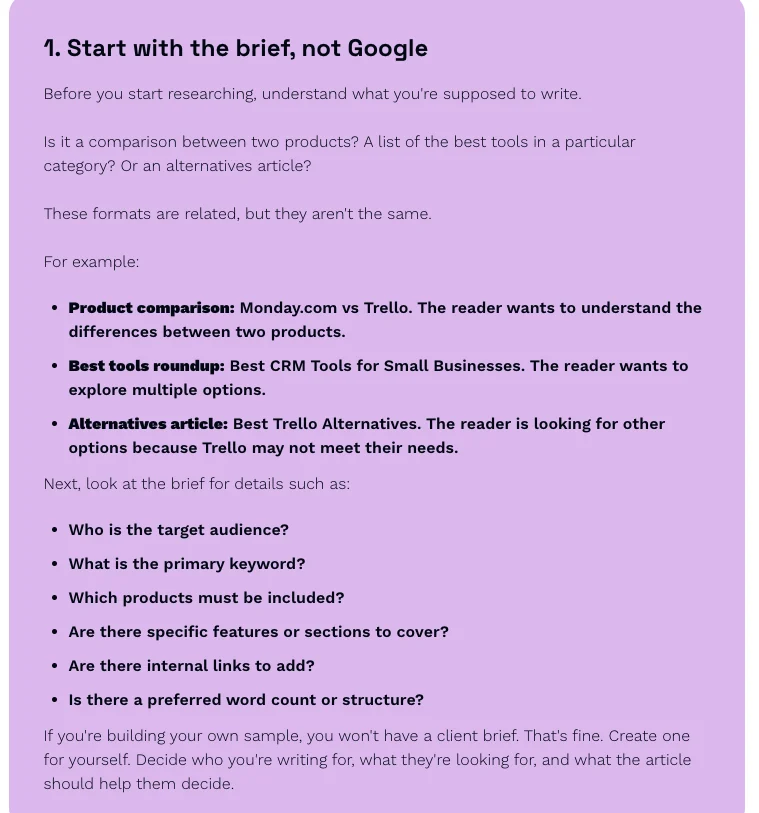
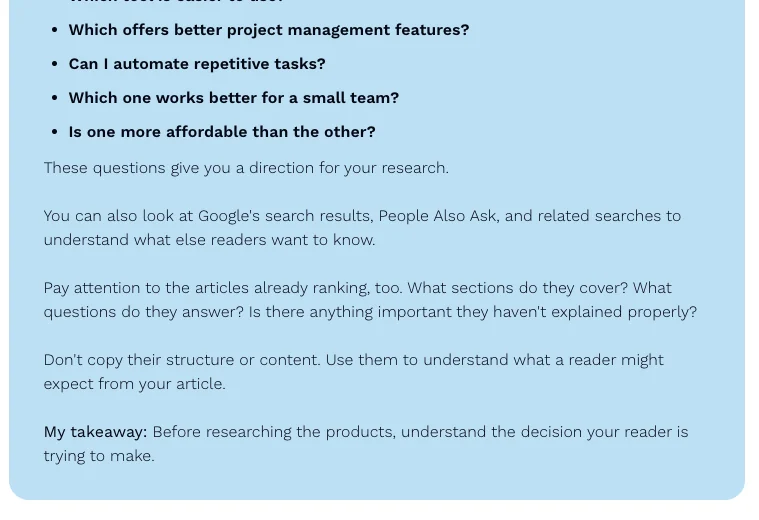
Each step uses the same order: the instruction as the heading, why it matters, a worked example from her own articles (Monday.com vs Trello), then a checklist. Step 2 ends on a labeled line, "My takeaway: Before researching the products, understand the decision your reader is trying to make."
The issue also keeps readers coming back. The October 31 issue, "Don't Ignore these 7 Client Red Flags," closed with "See you in the next edition with the GREEN FLAGS," and the November 14 issue opens by pointing back to that green flags edition. Both issues ask readers to hit reply and share their own experience.
Works because: every step is useful on its own, so a reader can skim to the one they need. The worked examples come from her own published pieces, which is the proof. But: at ten steps plus two tables and two lists, the issue runs to about 2,400 words. That is a lot for an inbox, so the colored step cards and numbered headings do real work.
Steal this: write each step heading as an instruction, then end the hardest step with one labeled takeaway line.
The Link Tank: Put a TL;DR Above a Long Guide
The Link Tank is Melanie Goodman's weekly newsletter on LinkedIn strategy, published on Substack. We read four recent public issues, from 1,526 to 3,546 words. Each one is a guide built on numbered steps, signals, or trends, and each closes with a wrap-up section, such as "The one thing to take away" or "The takeaway."
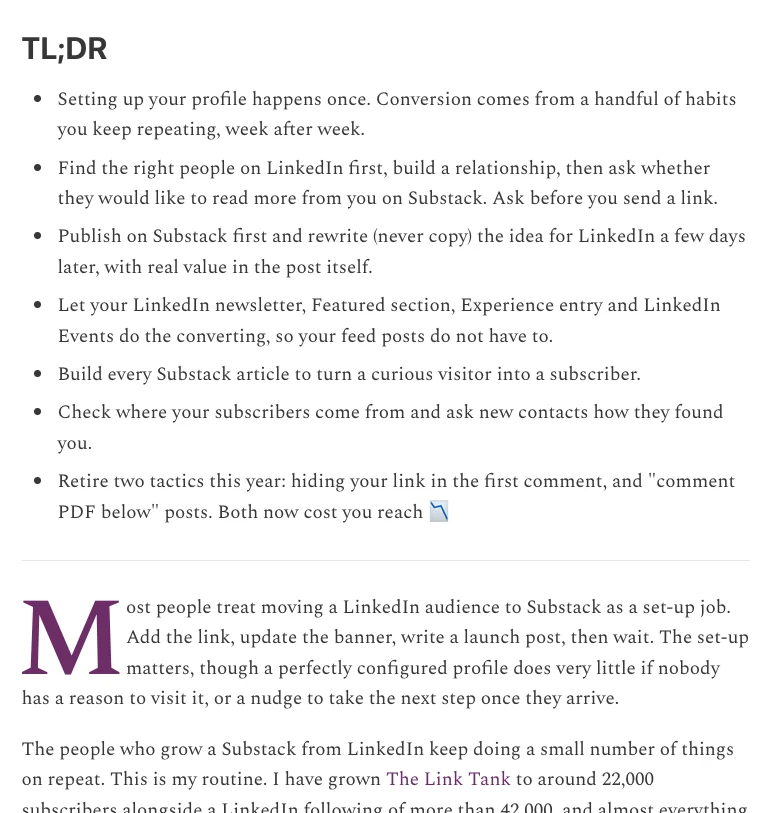
"How to Turn Your LinkedIn Followers into Substack Subscribers" (November 9, 2026) opens with a seven-point TL;DR before the first word of the story. A reader who stops there still gets the whole routine.
Then come nine numbered steps, each named for the action: "Step 2: Ask before you send a link." Inside, she pairs the advice with her own practice and, as a lawyer, a note on consent under UK GDPR, then gives the exact message she sends.
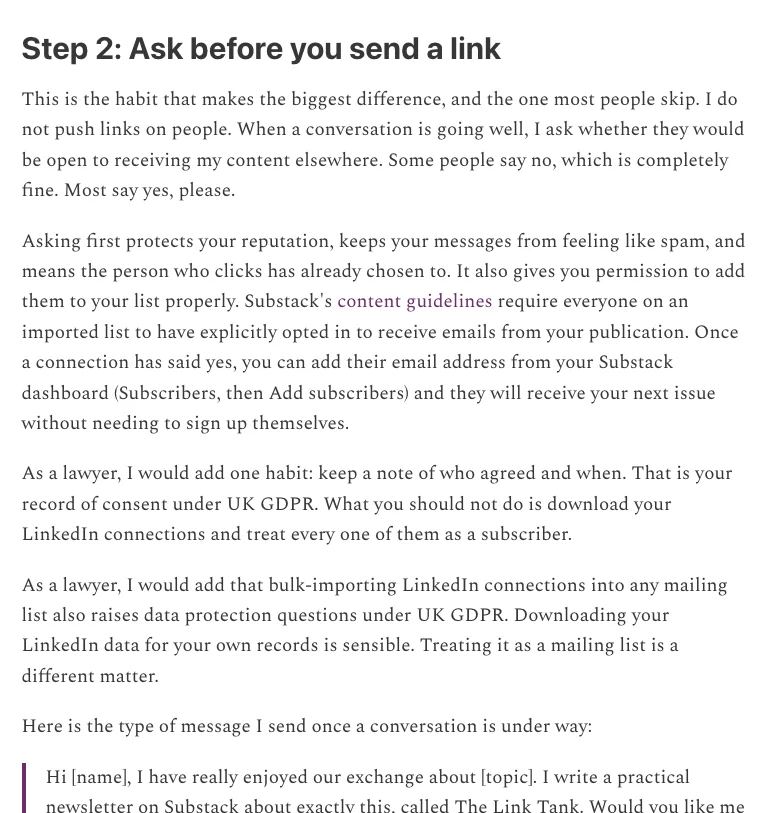
Works because: the TL;DR serves the skimmer and the steps serve the doer, in one issue. Copy-ready templates, like the message in Step 2, turn advice into something a reader can use today. But: long issues need a careful final read. In this one, two back-to-back paragraphs open with "As a lawyer, I would add," saying nearly the same thing.
Steal this: for any issue over about 1,500 words, write a bulleted TL;DR first, one line per step.
Print and Internal Newsletter Articles
Print, PDF, and staff newsletters still follow newsroom rules. These two show the structure that works when a reader holds the whole page.
Library of Congress Gazette: Write Like a Newsroom
The Library of Congress Gazette is the Library's weekly staff publication, with issues posted as PDFs. The November 20, 2026 issue (Volume 37, No. 45) opens with an "Inside" column: four teasers, each a headline, one line of context, and a page number. The lead story stacks a headline, a deck, and a byline, then opens with a list of objects from the exhibit before saying what opened.
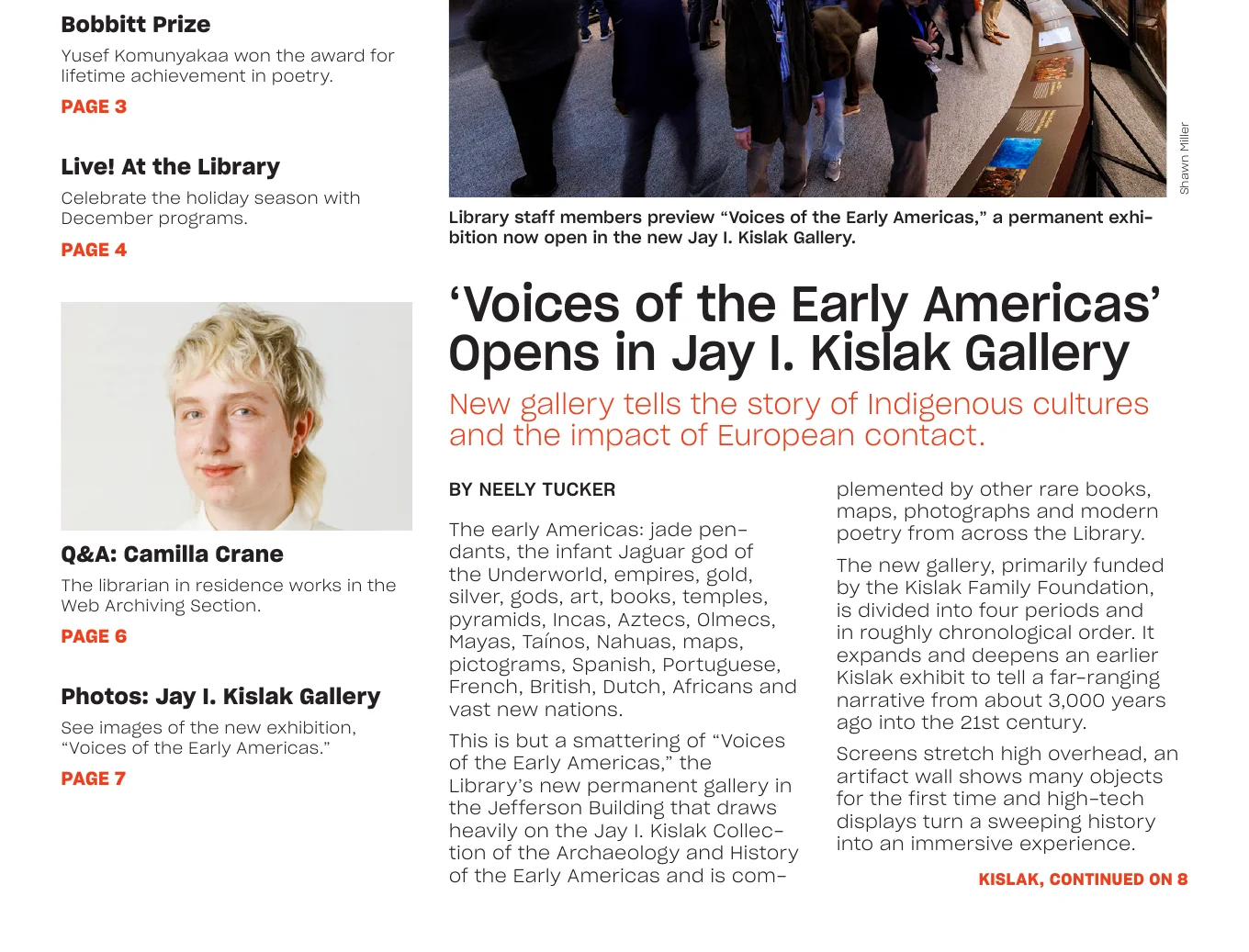
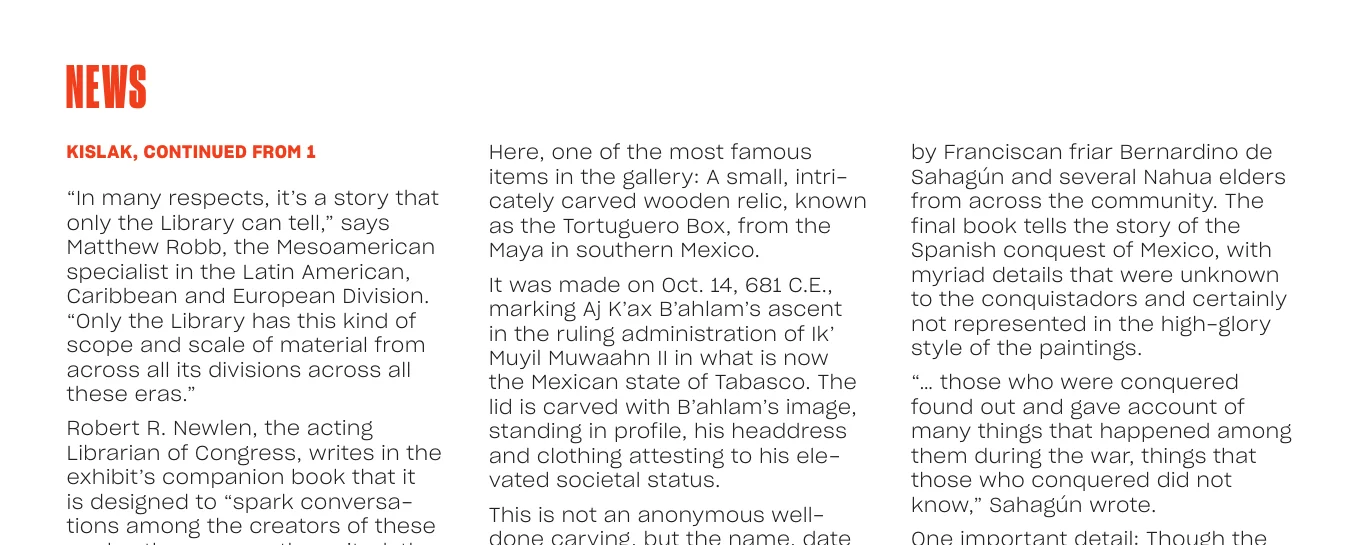
The story jumps to page 8 after 161 words, with a matching "continued from 1" label.
The same issue runs a staff Q&A on page 6. Each question is a bold subhead, so readers can jump to the one they care about.
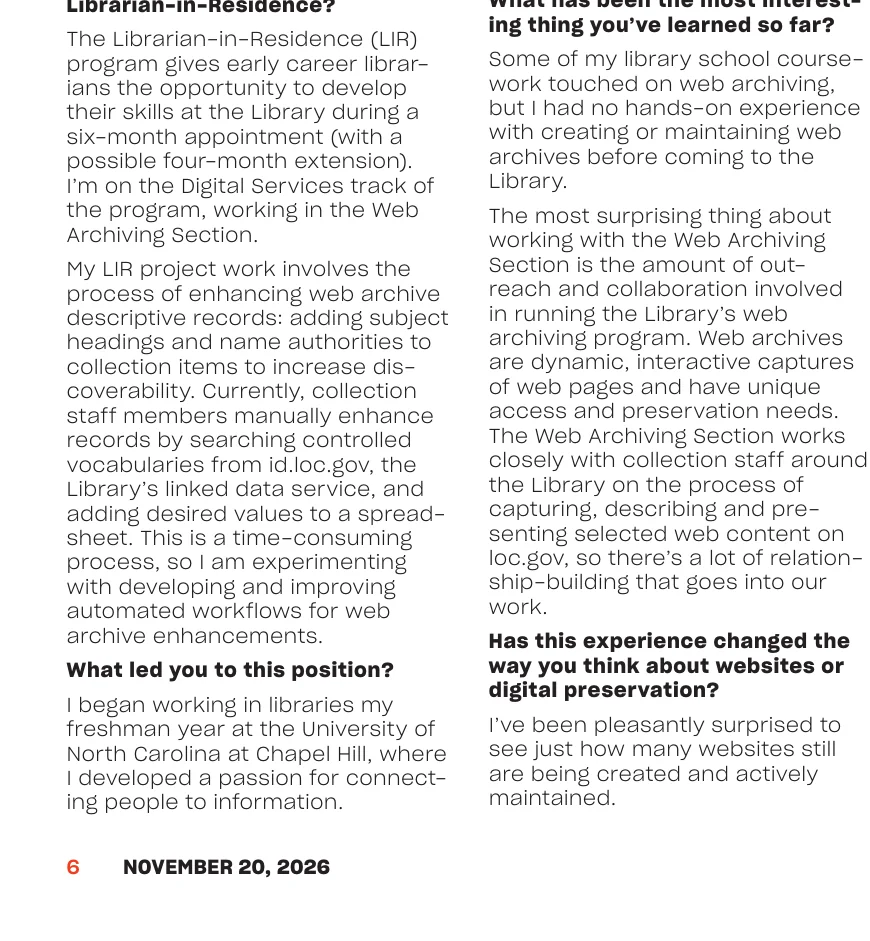
Works because: every part has one job. The deck adds the angle, the teaser sells the page, and the jump line keeps the cover readable. But: jump lines suit print and PDF. In email, readers won't scroll back to find "continued on 8."
Steal this: write a one-line deck for every feature. It forces you to know your angle before you write the lede.
Westchester Land Trust: Open on the Reader, Then Show the Impact
Westchester Land Trust, a land conservation group in Westchester County, New York, combined its Fall 2025 newsletter with its 2024 annual report in a 12-page PDF.

Its land-protection feature doesn't open on the land deal. It opens on the reader: "When our neighbors turn on the tap." Then it explains the forest, adds one quote from the president, uses the subhead "Partnerships Make It Happen" for the funding (a $1.35M state grant with a 25% town match), and ends with a boxed line crediting supporters with 9,300+ acres conserved.
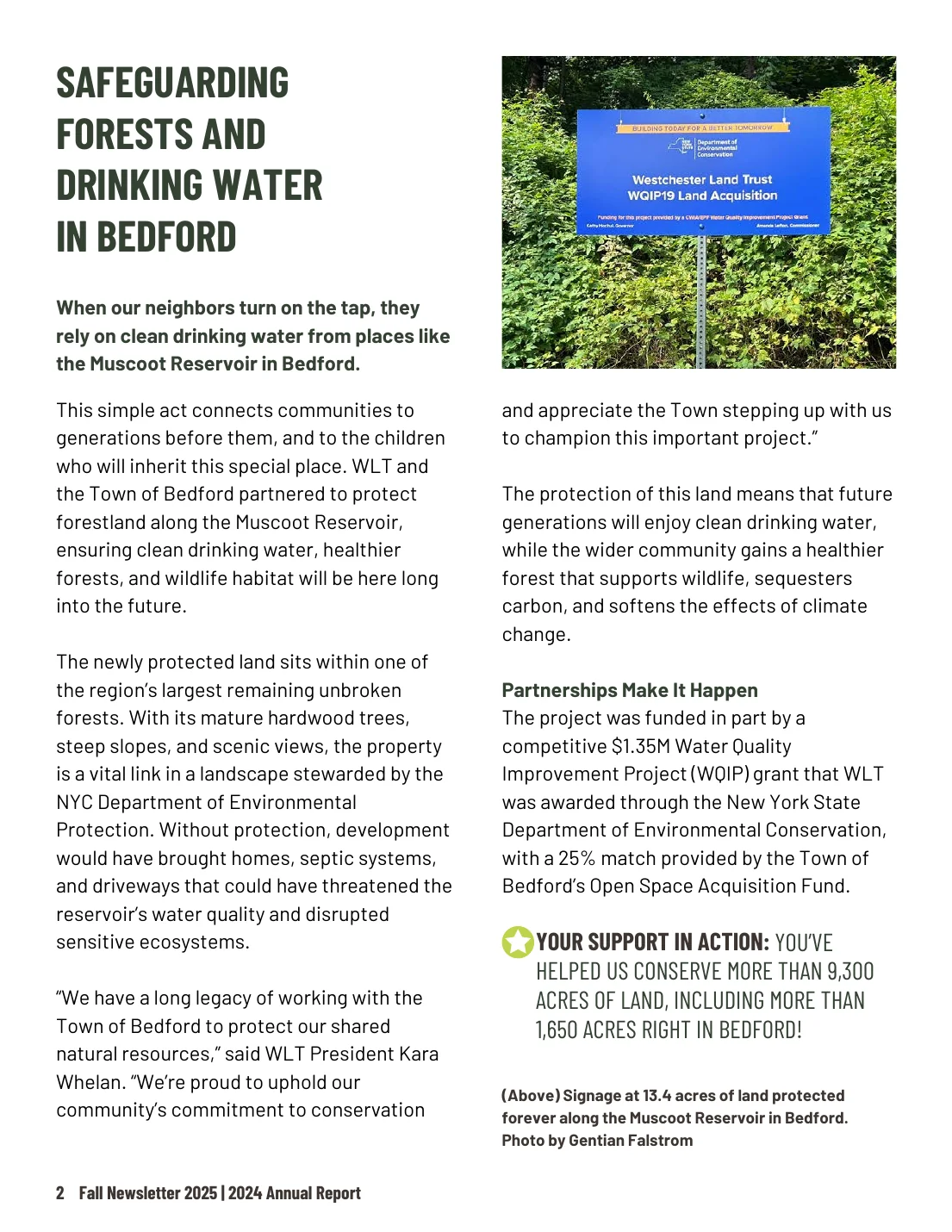
Works because: a donor reads "your water" before "our acquisition," so the stakes land first. But: at about 26 words per sentence, the body reads like a report. On a phone, the same text would need shorter sentences.
Steal this: rewrite your first sentence so the reader, not your organization, is the subject.
How Do You Write a Newsletter Article? Five Steps
Use the examples above as a checklist. These five steps work for a 50-word tip and a 250-word feature.
- Pick the job. Decide whether the reader should learn, try, attend, give, or reply. One job per section.
- Write the headline as the point. "Quick fix for leaks" (Recomendo) tells you what you get. Avoid clever labels that hide the topic.
- Put the news or claim in the first sentence. Nielsen Norman Group calls this the inverted pyramid: the most important information first, then supporting detail.
- Add one concrete detail and one "why it matters." A price, a count, a date, or a quote. Then say why the reader should care.
- End with one next step. A link, a reply prompt, or a page number. Not three.
Here's a quick before-and-after we wrote to show steps 2 to 5 on a typical internal update:
- Before: "Facilities Update. As many of you know, the facilities team has been working hard over the past several months on a number of improvements across our buildings."
- After: "Bike Room Opens Monday. The new bike room in Building B opens Monday with 40 racks and a repair stand. Bring your badge; the door is badge-only. Questions go to the facilities inbox."
The after version is 31 words. It names the change, gives two concrete details, and ends with what to do.
When Not to Copy These Patterns
Copy the move, not the format. Each pattern has a cost.
- Short items don't suit complex news. If a policy change needs context, a 90-word item will leave readers with questions. Write a longer piece and link to it.
- Personal letters need a known sender. A company newsletter written as "I" from no named person reads as fake.
- Recurring labels (such as "Why it matters") lose force if every section uses them. Save them for the section where the answer is not obvious.
- Numbered items imply equal weight. If one item matters far more, give it its own lead section.
- Print structure (decks, jump lines) adds production time. A two-person team sending a weekly email may not need it.
- Long guides need a reason to be one issue. If readers only need one step, send that step and link to the full guide.
If you only change one thing, move your point into the first sentence. That's the one habit every example here shares.
How We Chose These Examples
We picked issues that were public, recent, and readable without signing in, and we read each one in full. We mixed big names (Seth Godin, Ann Handley, The Pragmatic Engineer, the Library of Congress) with smaller ones (Recomendo, Why Is This Interesting?, Writerspause, The Link Tank, and a county land trust) and included print and internal staff newsletters, not only email. We have no commercial relationship with any newsletter here.
What goes into a good newsletter?
A good newsletter has a clear sender, sections that each make one point, and one next step per section. The best examples here open each section with the point, add a concrete detail such as a price or date, and label sponsored content clearly.
What are the 6 basic rules in laying out a newsletter?
There is no official set of six rules. From the examples here, six checks help: one point per section, the point in the headline or first line, short paragraphs, labeled sections, clearly marked ads, and one call to action per section.
What are the 12 essential parts of a newsletter?
No standard list of 12 parts exists. Common parts are a masthead, date or issue number, contents or teasers, headlines, decks, bylines, body text, subheads, images with captions, callouts, calls to action, and a footer. US commercial emails must also include a postal address and an opt-out under CAN-SPAM.
What are some good examples of email newsletters?
Recomendo (short recommendations), Why Is This Interesting? (question-framed essays), The Pragmatic Engineer (bold takeaways), Seth Godin's daily post, Ann Handley's Total Annarchy (themed numbered items), Writerspause (numbered how-to steps), and The Link Tank (long guides with a TL;DR) each show a distinct, copyable format.
How long should a newsletter article be?
For email, aim for about 50 to 160 words per section; that is what most sections in our sample ran. Print and internal features ran 160 to 260 words before a jump. At about 238 words per minute, a 100-word section takes roughly 25 seconds.
How do you start a newsletter article?
Start with the news, the claim, or the reader's stake in the first sentence. Westchester Land Trust opens on the reader's tap water, and the Library of Congress Gazette opens with vivid detail, then a headline and deck that say what happened.
Summarize this article with AI:
 ChatGPT
 Perplexity
 Claude
 Grok

Written by
Taher BatterywalaFounder & Chief Curator
Taher Batterywala is a creative marketer who loves to write & design content that organically drives conversions. He is the creator of Pineable, the world's first content marketing design inspiration hub. He regularly shares his thoughts about content design, SEO, and marketing. As a true cinephile, he admires movies above anything else.