On this page
A pitch deck is a short slide presentation that explains your business and asks investors, buyers, or partners for a specific commitment. Most founders use one to raise money. It usually runs 10 to 15 slides and covers the problem, your solution, the market, the business model, the team, and the ask.
Here are the key facts at a glance:
| Question | Answer |
|---|---|
| Purpose | Get a meeting, an investment, a deal, or a partnership |
| Typical length | About 10 to 15 slides |
| Where it's used | Investor emails, live pitches, demo days, sales and partner meetings |
| Who reads it | Venture capitalists, angel investors, buyers, and partners |
| Common formats | PDF, Google Slides, PowerPoint, Keynote, or a shareable link |
- A pitch deck is a 10 to 15 slide presentation that asks investors or partners for one clear commitment.
- Sequoia's classic outline runs from company purpose and problem through team, financials, and a five-year vision.
- Guy Kawasaki's 10/20/30 rule: ten slides, twenty minutes, and no font smaller than thirty points.
- DocSend data shows investors spend less than three minutes reviewing a deck, so every slide needs one point.
- Make two versions: a detailed send-ahead deck to read alone and a lighter deck to present live.
What Is a Pitch Deck Used For?
A pitch deck gets you to the next step, not the final yes. For a startup, that step is usually a first meeting or a follow-up call with an investor. For a sales team, it's a pilot or a proposal.
The deck does two jobs. First, it tells a story: here's a painful problem, here's how we solve it, and here's why we'll win. Second, it gives the reader enough proof to believe that story, such as traction, revenue, or a strong team.
Founders use pitch decks for fundraising rounds, accelerator applications, and demo days. Companies also use them to pitch partnerships, enterprise deals, and internal projects that need budget.
What Slides Go in a Pitch Deck?
Most investor decks follow the same core structure. Two of the most cited outlines come from Sequoia Capital and venture capitalist Guy Kawasaki.
Sequoia's guide to writing a business plan lists ten sections. Sequoia says Airbnb's founders used that guide when they built their first deck.
Here's how the two outlines compare:
| Sequoia's sections | Kawasaki's ten topics |
|---|---|
| Company purpose | Problem |
| Problem | Your solution |
| Solution | Business model |
| Why now? | Underlying magic or technology |
| Market potential | Marketing and sales |
| Competition and alternatives | Competition |
| Business model | Team |
| Team | Projections and milestones |
| Financials | Status and timeline |
| Vision | Summary and call to action |
The overlap is the real lesson. Every strong deck covers the problem, the solution, the market, how you make money, who you're up against, and why your team can pull it off.
Sequoia's "Why now?" slide is the one founders skip most often. It explains why this business works today and didn't five years ago. A new regulation, a cost drop, or a platform shift all count.
How Long Should a Pitch Deck Be?
Aim for about 10 to 15 slides. Shorter is usually better, because investors read fast.
Guy Kawasaki's 10/20/30 rule is the classic benchmark: ten slides, no more than twenty minutes, and no font smaller than thirty points. He wrote it as a venture capitalist tired of sixty-slide pitches, and he says it applies to any presentation meant to reach agreement.
Reading time is shrinking too. DocSend's pitch deck research says investors spend less than 3 minutes reviewing pitch decks. In 2020, investors spent over four minutes on decks that went on to raise money and only 1 minute, 30 seconds on decks that didn't.
That's the case for one idea per slide. If a slide needs a paragraph to make sense, split it or cut it. Move supporting detail to an appendix you can share after the meeting.
Types of Pitch Decks
Not every pitch deck does the same job. Pick the type based on who will see it and whether you'll be in the room.
| Type | When to use it | What's different |
|---|---|---|
| Send-ahead deck | Emailed to investors before a meeting | More text, so it makes sense without you |
| Presentation deck | Shown live in a meeting | Fewer words, bigger visuals, you do the talking |
| Demo day deck | Short stage pitches at accelerators or events | Very few slides, one big number per slide |
| Sales pitch deck | Pitching a product to a buyer | Focuses on the customer's problem, proof, and pricing |
| Partnership deck | Proposing a joint venture or co-marketing deal | Highlights mutual benefit and shared audience |
Most founders need at least two of these. A send-ahead deck that works alone often reads as cluttered on a big screen. A clean presentation deck often confuses someone reading it cold.
Pitch Deck Examples
The most useful examples show how real companies handle the core slides. Look for three things when you study one: how fast the problem lands, how they prove traction, and how specific the ask is.
Problem Slide: Front's Series B Deck
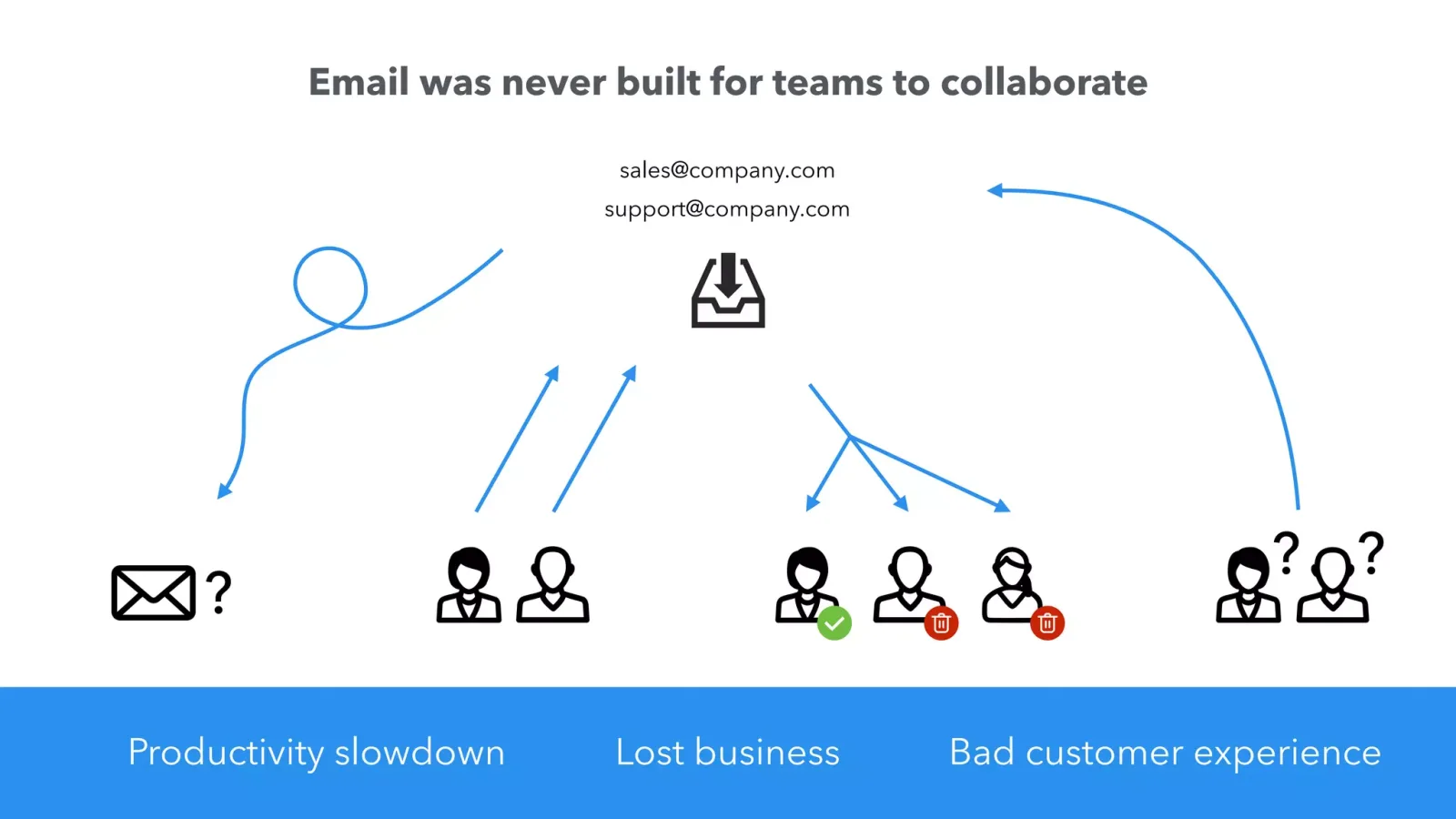
Front's problem slide makes one claim in its headline: email was never built for teams to collaborate. A simple diagram shows messages bouncing between teammates, and three costs run along the bottom: productivity slowdown, lost business, and bad customer experience. That last line tells an investor why the problem is worth money. Front's cofounder Mathilde Collin published the full deck in March 2018, after the company raised $66 million in a round led by Sequoia.
Traction Slide: Buffer's Seed Round Deck
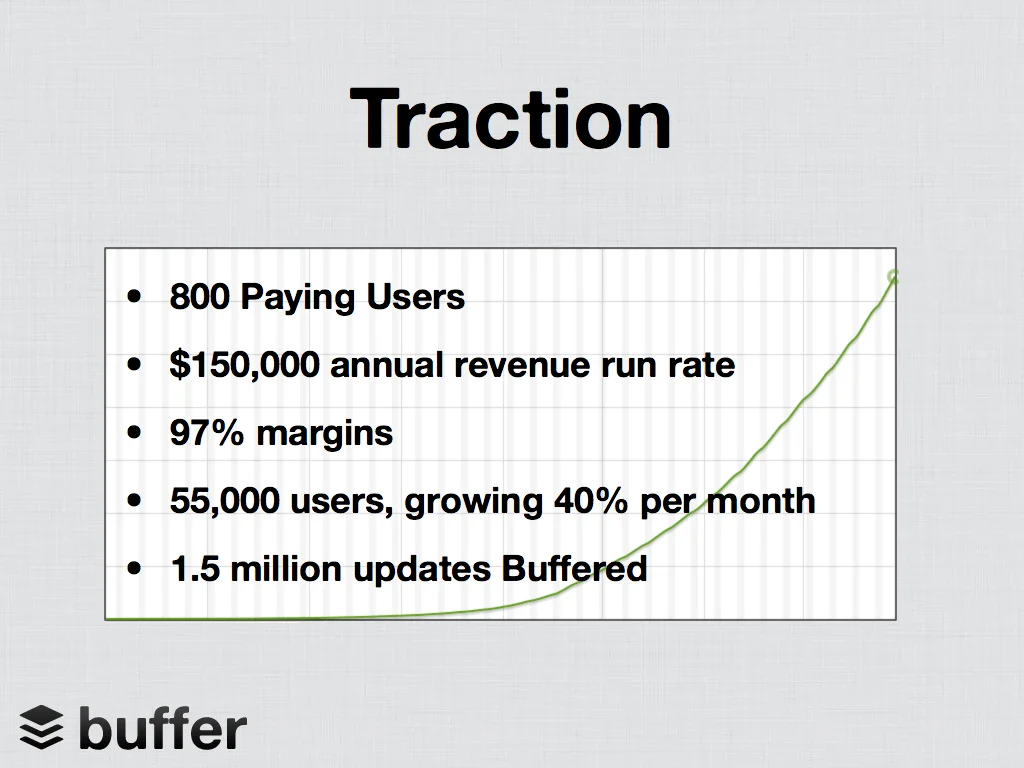
Buffer's traction slide stacks five numbers over a growth curve: 800 paying users, a $150,000 annual revenue run rate, 97% margins, 55,000 users growing 40% per month, and 1.5 million updates shared. Buffer shared the deck publicly and called traction the slide that mattered most for first-time founders.
Ask Slide: Front's Series B Plan
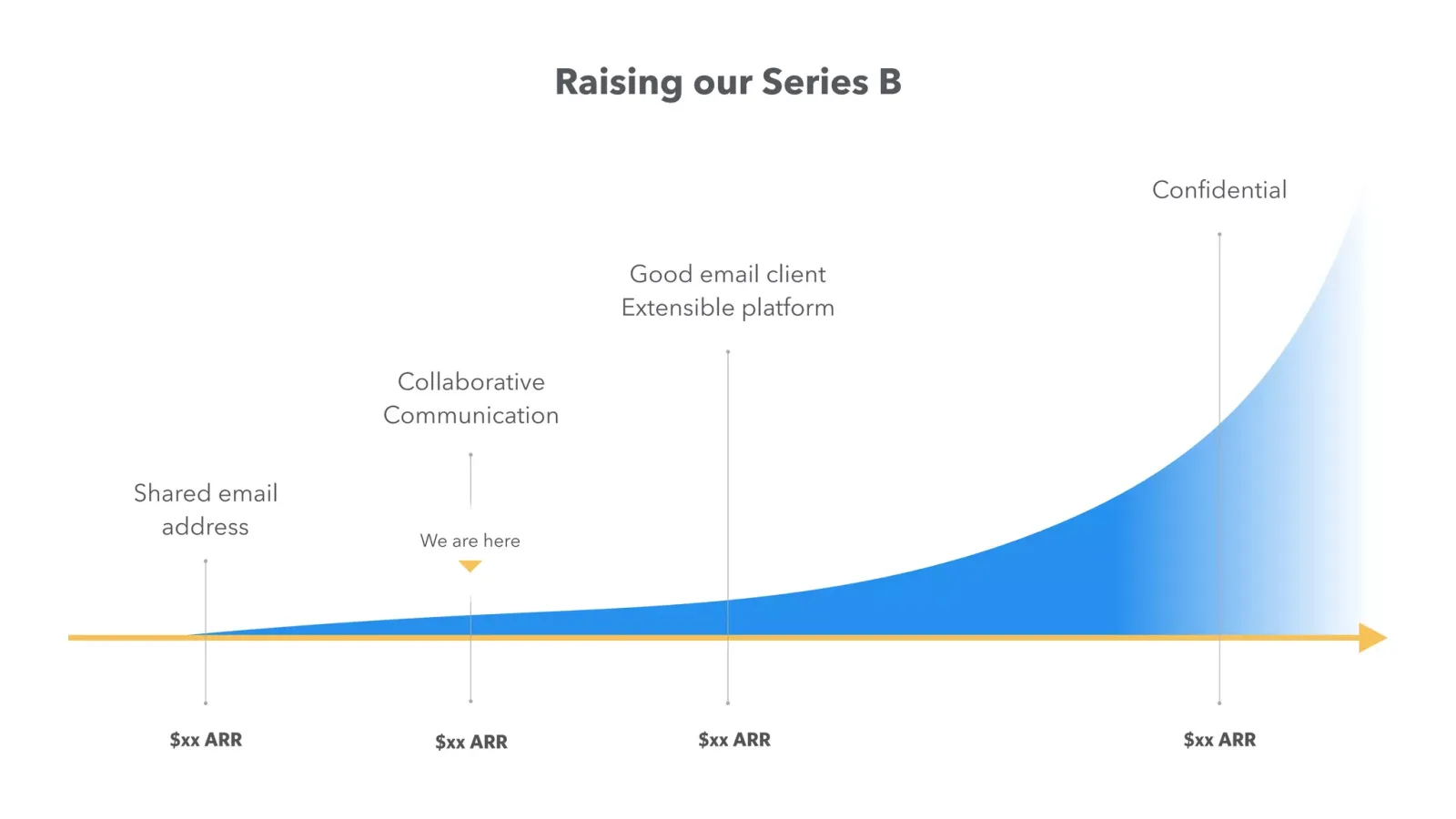
Instead of a bare dollar figure, Front's ask slide ties the round to milestones. A growth curve moves from a shared email address to collaborative communication, then to a good email client and an extensible platform, with a "We are here" marker. The revenue figures are redacted in the public version, but the structure shows how to connect an ask to what the money unlocks.
When you collect examples, note the slide order as well as the design. You'll often find that the best decks put traction early, right after the solution, when the numbers are strong.
Pitch Deck Design Tips
Design should make your argument easier to follow. It shouldn't be the argument.
- One message per slide. Write the takeaway as the slide title, such as "Customers onboard in a day, not a month."
- Large type. Kawasaki's thirty-point floor forces you to cut words.
- Charts over tables. Show growth as a line, not a grid of numbers.
- Consistent layout. Keep logos, colors, and title positions the same on every slide.
- Real product visuals. A screenshot of your product beats a stock photo every time.
AI tools can speed up the first draft. Our roundup of the best AI presentation makers compares the main options, and our Gamma AI review covers one popular choice in depth. Plan to rewrite the copy yourself, because investors can spot generic AI text fast.
What is a pitch deck?
A pitch deck is a short slide presentation, usually 10 to 15 slides, that explains a business and asks investors or partners for a commitment. It covers the problem, solution, market, business model, team, and the ask.
How many slides should a pitch deck have?
Aim for 10 to 15 slides. Guy Kawasaki's 10/20/30 rule recommends ten slides in twenty minutes with no font smaller than thirty points. Put extra detail in an appendix.
What is the difference between a pitch deck and a business plan?
A pitch deck is a short visual summary meant to win a meeting or deal. A business plan is a longer written document with detailed operations, financials, and strategy. Investors usually ask for the deck first.
What should the first slide of a pitch deck say?
The first slide should state your company name and a one-line description of what you do. Sequoia calls this the company purpose: define the company in a single clear sentence.
What is an infographic presentation?
An infographic presentation uses charts, icons, and short labels instead of paragraphs to explain data or a process. Pitch decks often borrow this style for market size, traction, and business model slides.
What is the best AI presentation maker for pitch decks?
Gamma, Canva, and Beautiful.ai are popular choices for drafting pitch decks quickly. Pick based on where you'll edit: Canva for design flexibility, Gamma for fast drafts, and PowerPoint add-ins for corporate templates.
Summarize this article with AI:
 ChatGPT
 Perplexity
 Claude
 Grok

Written by
Taher BatterywalaFounder & Chief Curator
Taher Batterywala is a creative marketer who loves to write & design content that organically drives conversions. He is the creator of Pineable, the world's first content marketing design inspiration hub. He regularly shares his thoughts about content design, SEO, and marketing. As a true cinephile, he admires movies above anything else.